From the Arctic Circle to the South Seas, whaling was the backbone industry for a great many people and cultures. Born on Nantucket and refined in New Bedford, it dominated a global market for more than two hundred years and left its mark on a surprising number of spheres of influence, the literary one included — Melville's Moby-Dick is still regularly called the great American novel, and it begins a short walk from where this bookstore stood.
This was the store's standing whaling list: a cross-section meant to give a reader some sense of the scope and magnitude of a once-great industry, and of the lives of the people who called themselves whalers.
The voyage itself
The best introductions to whaling are the ones that put you on the deck. Gordon Grant's Greasy Luck: A Whaling Sketchbook (reprinted by Dover) carries sixty-four full-page drawings of a whaling voyage and its adventures — the excitement, the tedium, the exhaustion, a whale breaching, a Nantucket sleigh ride, examples of scrimshaw, views of the fo'c's'le, galley and deck. The title comes from the cheer that went up at dockside as a crew was seen off: greasy luck, meaning a full hold.
Jim Murphy's Gone A-Whaling takes the same material for younger readers and is honest about it, telling the story through the journals and letters of young whalers and refusing to flinch from either the profit or the slaughter. Joan Druett's In the Wake of Madness reconstructs the notorious 1841 voyage of the Fairhaven whaleship Sharon, which is one of the strangest and darkest stories the industry produced.
The gear and the craft
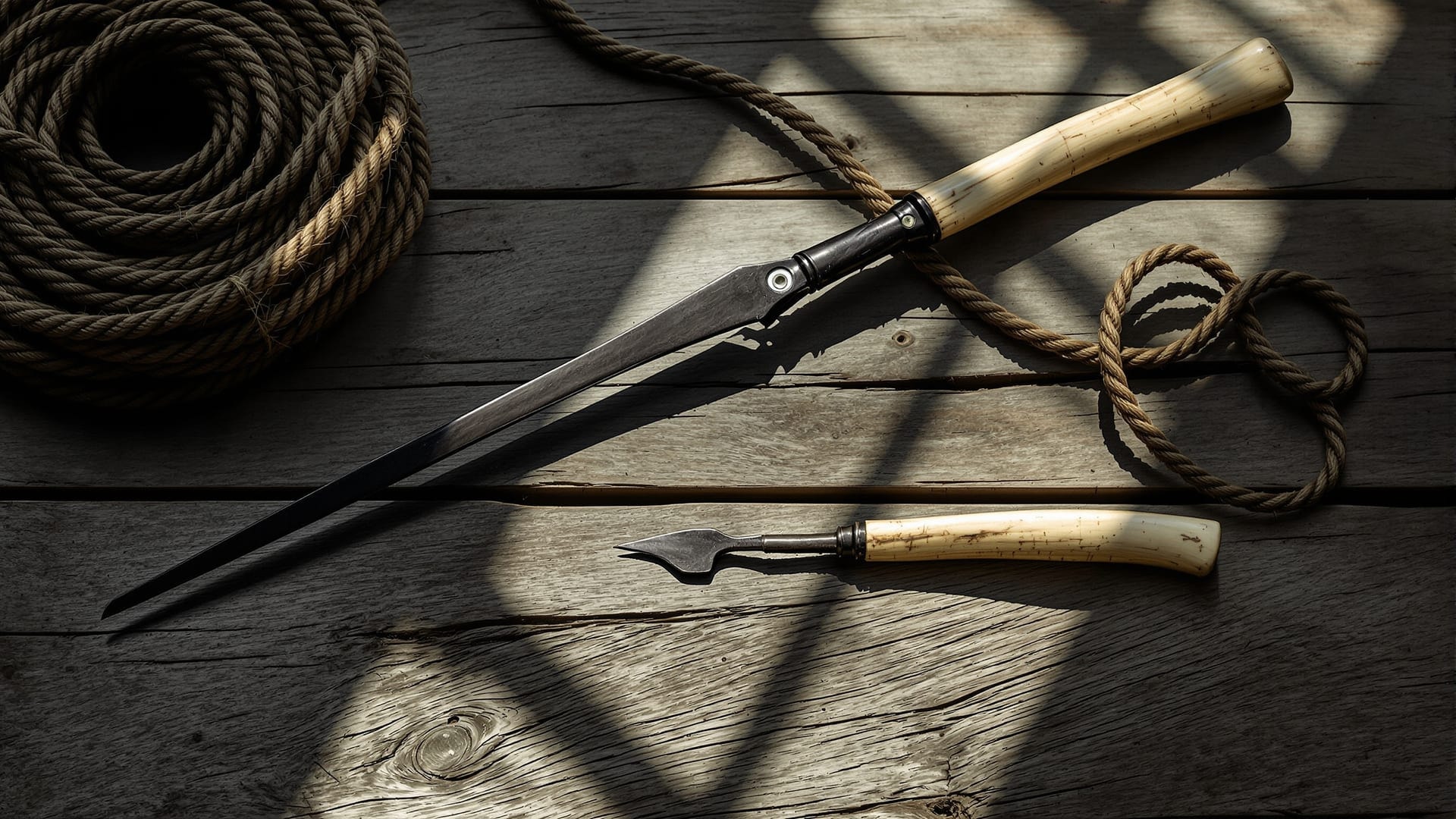
Whaling was a manufacturing economy as much as a hunting one, and the shore trades that supplied it are a subject in themselves. Thomas G. Lytle's Harpoons and Other Whalecraft (Old Dartmouth Historical Society, 1984) is the reference on the forging of whaling implements — the blacksmiths and engineers who set up shops in and around New Bedford to make and refine the harpoons, lances and spades used and abused in the fishery. It works both as a collector's reference and as a chronology of the trade, placing each advance in harpoon design in its period, which makes it unexpectedly valuable to model builders and writers as well as historians.
Scrimshaw — engraving on whale ivory and bone, often tinted to bring out the design — is the industry's best-known folk art, and it came directly out of the long empty stretches of a voyage, passed from sailor to sailor. It is one of the few art forms generally recognised as indigenously American. Modern manuals treat it as a live craft using contemporary substitute materials rather than ivory.
The ships and the yards
Southeastern Massachusetts built as well as sailed. Edward F. R. Wood's The Ports of Old Rochester: Shipbuilding at Mattapoisett and Marion (Old Dartmouth Historical Society, 2004) assembles the data on every vessel built in those towns and every whaling voyage begun from them, including the whalers Niger, Platina and Wanderer, which historians still single out for their lines. It is a reference work that reads well, partly because it reprints contemporary articles about the vessels from a period when the Yankee whaling trade was current news rather than history.
Of all the American sailing whaleships, exactly one survives: the Charles W. Morgan, launched in 1841 and now at Mystic Seaport. Her survival is the reason a modern reader can walk the deck of a whaler at all. The Mystic Seaport collections and research site is the place to follow that up.
Why the shelf mattered here
In most of the country whaling is a curiosity. In New Bedford it is the reason the city exists in the form it does — the source of the capital that built the mills, the reason for the Cape Verdean and Azorean communities that crewed the ships, the origin of the port infrastructure that the modern fishing fleet still uses. A whaling shelf here is local history, not maritime exotica. The New Bedford Whaling Museum holds the largest collection on the subject anywhere, and its research topics are the natural next step from any of these books.