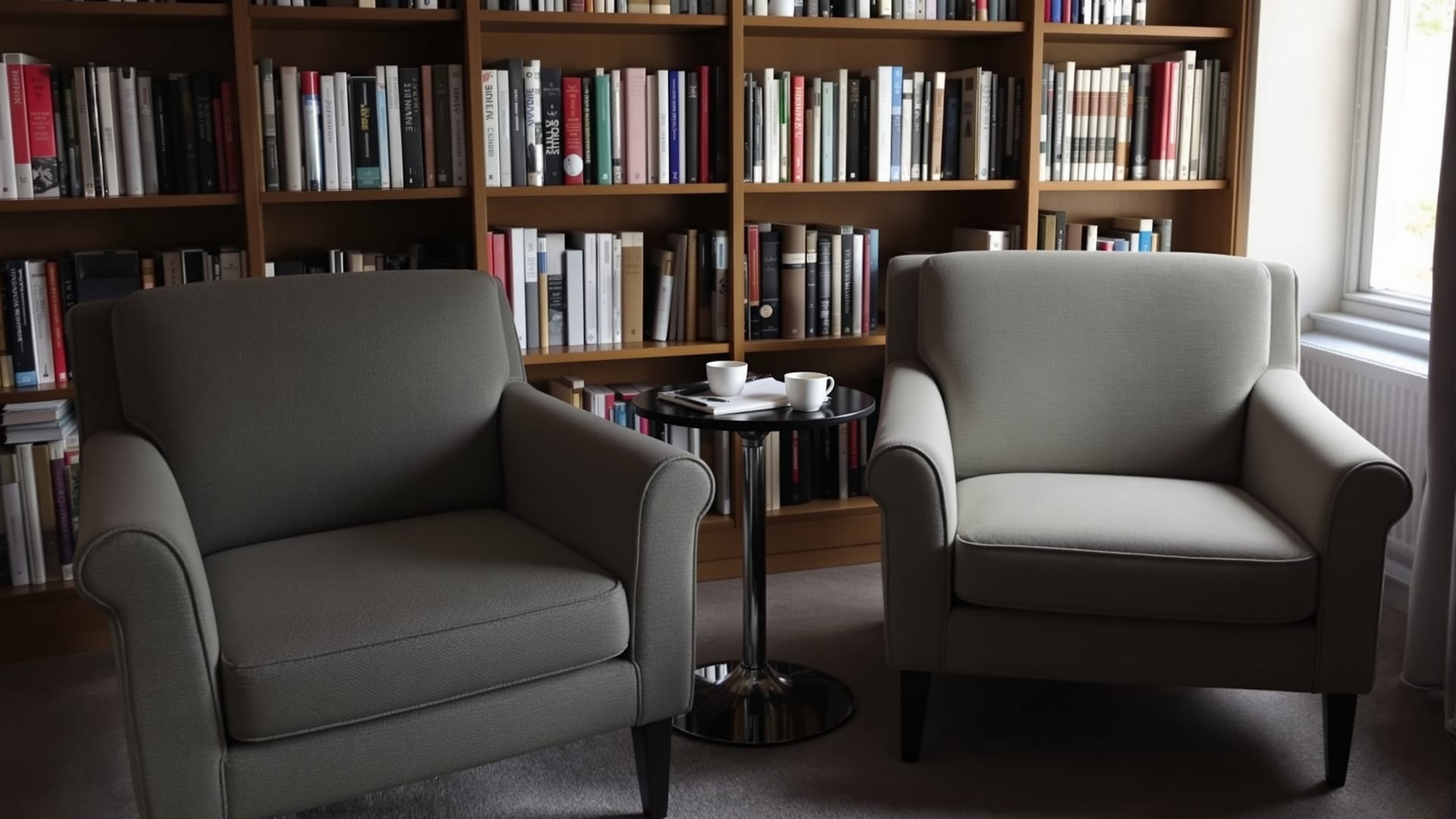
Alongside its live events, Baker Books ran a written interview series called Author Chats: long-form conversations with authors who had visited or were about to, conducted by a member of the store's own staff and published on the shop's website.
The interviews are not included. They were the copyrighted work of the interviewer and the authors involved, and the interviewer was a private individual whose byline is not carried forward here. What follows describes the series.
What it was
These were not publicity Q&As. They ran to several thousand words, they went into method, and they were conducted by someone who had read the whole back catalogue rather than the press release. The questions tended to be about the awkward things: why an author had abandoned the setting and the community that had defined four previous novels; how illness had interrupted a book and what the interruption did to it; what a writer owed to the place they came from.
The novelists interviewed were mostly New England writers or writers with a New England connection, consistent with the store's Open Book Series and its local-author shelf. Among those who appeared at the store over the years were Suzanne Strempek Shea, Elizabeth Graver, Linda Greenlaw, Ann Hood, Jennifer Haigh and Jill McCorkle.
Why bookshop interviews are different
Three things separate an interview conducted by a bookseller from one conducted by a journalist.
The interviewer has sold the books. A bookseller knows which of an author's titles moves, who buys it, what people say when they bring it back to the counter, and which one is hardest to hand-sell. That is a body of knowledge no critic has and no publicist will volunteer.
There is no news peg. A newspaper interview exists because a book is out this week and dies with the news cycle. A bookshop interview exists because the store found the writer interesting, which means it can go where it likes and stays readable for years.
The audience is specific. The reader of an Author Chat was a customer of this shop, in this region, who might well come to the event a fortnight later. The interviewer could assume a shared context — the local literary scene, the region, the other books on the same shelf — that a national interview cannot.
A note on Suzanne Strempek Shea
One connection is worth recording, because it explains why the series existed at all. Suzanne Strempek Shea, a Massachusetts novelist who was awarded the New England Book Award for Fiction in 2000, wrote a memoir called Shelf Life about spending a year working in an independent bookstore. A shop like Baker Books hosting a writer like that is not a promotional exercise; it is a conversation between two parties in the same trade.
Why the interviews are omitted
The interviews were substantial pieces of work and it would be easy to argue for republishing them. The interviews are omitted for two reasons.
They were copyrighted collaborative work — the interviewer's questions and framing, and the authors' answers. Publishing several thousand words of a novelist's conversation would require rights this site does not hold.
And they were bylined by a private individual, a bookseller at the shop who has no continuing connection to any of this. A person's writing should not be republished without permission on a site they have no involvement with. So the series is described here and not reprinted.
What became of the format
The bookseller interview did not survive the shift to social media, which rewarded brevity and immediacy over four-thousand-word conversations posted without a schedule. The nearest surviving equivalents are the podcast interviews run by a handful of independent shops, which have most of the same virtues and reach a wider audience.
The store's live counterparts to this series are described on the events page and the Open Book Series page. For current author interviews and reading programmes nationally, the National Book Foundation maintains an extensive free archive, and the Poetry Foundation does the same on the poetry side.