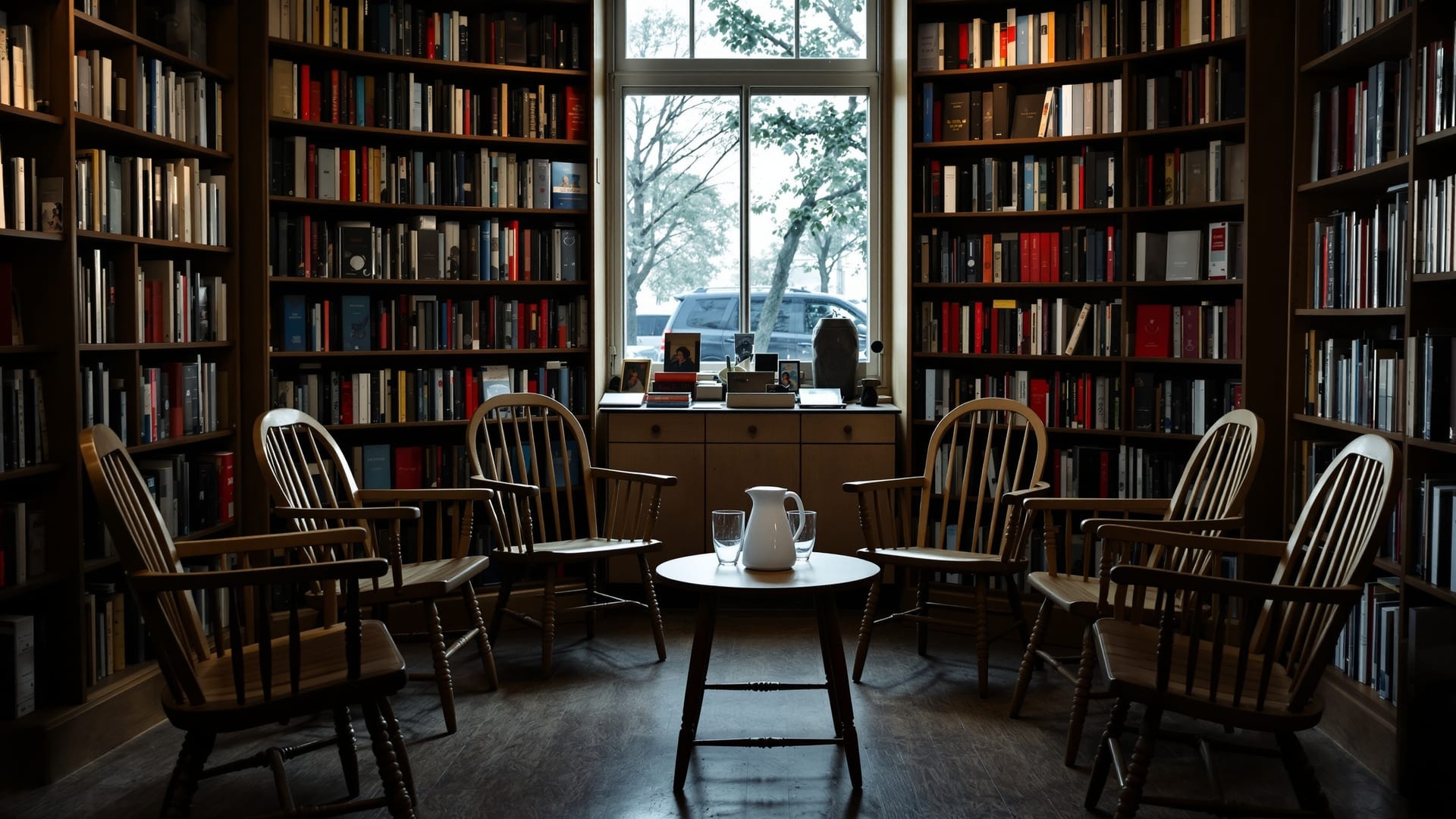
Most bookshop event programmes are fiction programmes with occasional non-fiction attached. Baker Books ran a separate strand for serious non-fiction, billed as Hot Topics, and it was the most argumentative thing the store did.
The format was a discussion and book signing rather than a reading: an author, a subject, and an audience expected to have opinions. Events were free, and in the small-room years a seat had to be reserved because the space held perhaps forty people.
The subjects
A representative run from the early 2000s gives the flavour, and it is worth noting how little any of it has aged:
- Privacy. A psychotherapist and writer on why we enjoy more privacy than ever before and yet feel we have none — the encroachment of media, computer data-gathering and electronic surveillance — argued through a series of specific settings: the bedroom, the consulting room, biography, the presidency, women's bodies, and post-2001 security policy. Her case was that having a say in when and how we watch one another is central to any real account of freedom.
- The morality of war. A discussion of just-war theory as applied to American conflicts, held while the country was actively arguing about a war.
- The social roots of school shootings. A sociological treatment of rampage violence, taken as a structural problem in communities rather than as a series of individual pathologies.
These are not comfortable evenings, and they are not obvious retail. A shop that programmes them is making a decision about what it is for.
Why run it
Three reasons, all of which apply to any independent bookshop considering the same thing.
It brings in a different audience. The people who turn out for a discussion of surveillance policy are not the people who turn out for a novelist, and a large share of them had not previously thought of the shop as somewhere they went.
It uses the room properly. A reading is a performance and the audience is passive. A discussion needs a room where forty people can face each other and argue, which is precisely what a café corner with movable chairs provides.
It makes the non-fiction section visible. General bookshops sell an enormous amount of non-fiction and almost never programme it. The result is that the current-affairs and history shelves get browsed by people who already read them, while the events calendar recruits only fiction readers.
Choosing the subjects
The selection principle appears to have been simple: take the non-fiction books the booksellers were arguing about in the back room, and see whether the author would come. That produces a very different list from one assembled by asking which titles are selling, and it explains why the series covered surveillance and just-war theory in a suburban bookshop rather than gardening and local cookery.
The practical constraints were real. A discussion evening needs an author willing to be questioned rather than applauded, an audience prepared to have read the book, and a room small enough that nobody can hide in it. Forty seats is close to ideal; two hundred is a lecture and eight is a seminar. The store's café room happened to sit exactly in that range, which is probably why the series existed at all.
Difficulty, handled
The store handled contentious material with the same instinct it brought to Banned Books Week: put the difficult thing in front of people, let the author make the argument, and trust the audience. It did not soften the subjects in the billing, and it did not pretend a book about school shootings was about something else.
The other event strands — the Open Book fiction series, the weekly children's story hour and the author readings — are described on the events page.
For the wider public-discussion tradition these evenings belong to, the National Endowment for the Humanities funds much of the reading-and-discussion programming that runs through American libraries, and the American Library Association supports the same work on the library side.